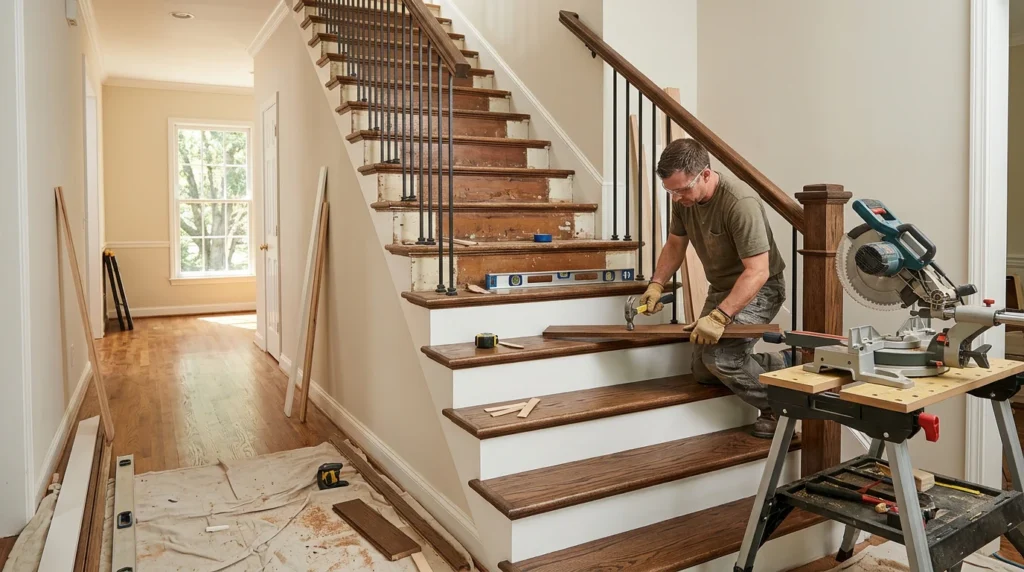
Quick answer: A staircase renovation typically includes structural tightening or repairs, safety upgrades to the handrail/guard system, finish updates to treads/risers/trim, and jobsite planning so the house stays usable. Many projects address squeaks, bounce, loose or cracked parts, and dated railings, then wrap up with stain/paint and clean transitions at landings. Scope varies, but a good plan separates structure, safety, finishes, and logistics from the start.
What a Typical Staircase Renovation Covers
A staircase renovation can be as small as fixing squeaks and refinishing, or as involved as rebuilding parts of the framing and replacing the railing system. Most homeowners start because the stairs feel noisy, springy, or dated, and they want a safer, cleaner look that matches the rest of the house. If you’re researching staircase renovation Athens GA, expect the conversation to include both the “bones” (structure) and the “skin” (visible finishes).
Here’s a clearer checklist of what’s commonly included, organized the way many contractors scope it:
Structural: evaluate stringers for cracks/splits, re-fastening treads/risers, adding blocking or adhesive where appropriate to reduce movement, correcting bounce, and addressing squeaks caused by wood-on-wood rubbing or loosened fasteners.
Safety / code-aligned items: tightening or replacing newel posts, guards, and balusters; updating handrail profile for graspability; checking guard/handrail height and opening spacing against applicable requirements (often based on the IRC with state/local amendments). Requirements can vary by situation, so verification with the local authority is the safe move.
Finish: new or refinished treads, painted or stained risers, nosing repairs, skirt boards/trim, and blending stain/paint sheen to nearby flooring and baseboards.
Site logistics: dust control and floor protection, how long stairs may be out of service, safe temporary access plans, and cleanup expectations.
Athens-Specific Expectations: Permits, Inspections, and Older-Home Quirks
In Athens-Clarke County, permit and inspection needs often depend on what you’re changing. Replacing finishes (like sanding/staining, or swapping cosmetic trim) may be treated differently than altering guards/handrails, moving walls, changing stair geometry, or modifying structure. If you’re planning a new guard/handrail system or structural changes, it’s smart to check directly with the Athens-Clarke County Building Inspections division before work begins so you know what triggers review and what documentation they want.
For trustworthy baseline guidance, many local requirements trace back to the International Residential Code (IRC) as adopted and amended by Georgia, with local enforcement decisions on top. You can reference the Georgia Department of Community Affairs (DCA) for Georgia State Minimum Standard Codes and amendments, and use the IRC stair/handrail/guard sections as a starting point—then confirm the interpretation with Athens-Clarke County for your exact stair and occupancy.
Older Athens-area homes commonly have quirks that affect stair work: out-of-square walls that make skirt boards tricky, patched flooring at landings, inconsistent riser heights from past remodels, and railings that were “good enough” decades ago but feel loose by today’s expectations. A careful renovation plan accounts for these realities so the finished stair looks intentional and feels solid, not like a series of small fixes.
Signs You Need More Than Cosmetic Updates
Cosmetic work won’t solve a staircase that’s moving underfoot. If you feel bounce, see gaps opening between treads and risers, or notice the railing flexing when you grip it, the fix usually needs more than sanding and stain. Persistent squeaks can be a symptom of wood-on-wood movement, loose fasteners, or undersupported treads.
Safety red flags deserve extra caution: uneven step heights, a handrail that’s hard to grasp, baluster spacing that could allow a small child to slip through, or a guardrail that’s low or wobbly at an open side. Any sign of water damage—soft spots, staining, or crumbly wood—can indicate rot that needs structural attention before finishes go on.
Next Steps: What to Gather, What to Ask, and When It’s Urgent
Before you schedule estimates, gather a few basics so you get more accurate recommendations: photos from the top and bottom of the stair, close-ups of any cracks/gaps, a side view of the railing and newel posts, and a shot showing how the stair meets the landing/flooring. If you can, measure the stair width, count the number of steps, and note any noticeably “taller” or “shorter” risers. Also note what you want to keep (existing treads, railing style) versus what you’re open to changing.
During an estimate, ask decision-making questions: What’s causing the movement or squeaks, and what specific fastening or blocking approach will address it? If the railing is being updated, which parts are being reinforced or replaced (posts, balusters, handrail), and how will rigidity be ensured? What code references are being used as a guide (typically IRC/Georgia amendments), and will you recommend confirming permit/inspection requirements with Athens-Clarke County for this scope? How will dust be controlled, and how long will the stairs be partially or fully unusable?
Treat it as urgent if the railing moves noticeably, a tread feels loose, riser heights feel inconsistent enough to trip you, or there are signs of rot or structural cracking. In those cases, prioritize stabilizing the stair and railing first, then finalize finish choices. For help scoping the work and getting clear answers to the questions above, contact Tipton’s Fine-Tuned Carpentry for an on-site evaluation and a written plan.