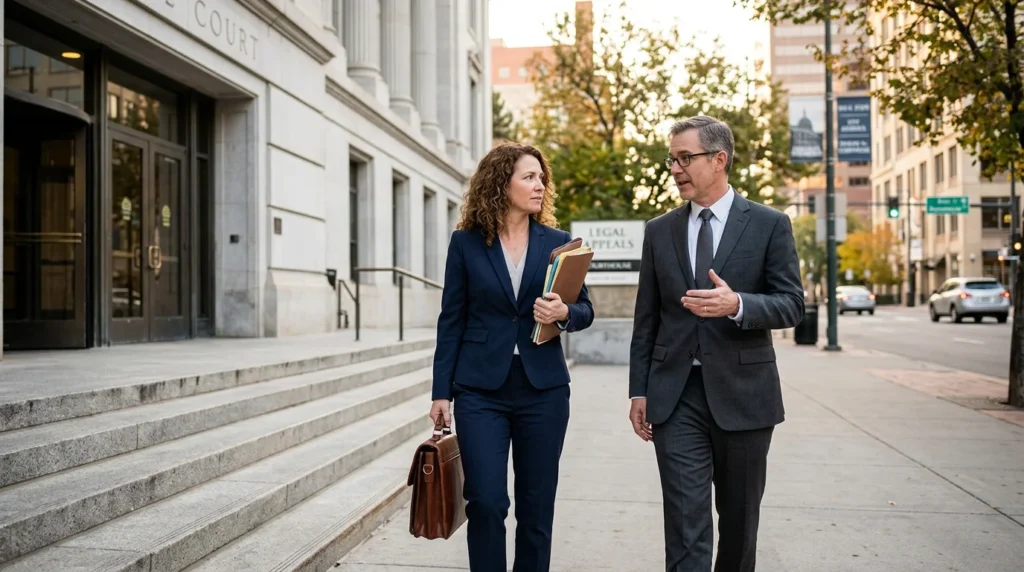
Quick answer: You usually need a criminal appeals attorney if you believe legal errors affected your conviction or sentence, or if new information could change the outcome. Appeals aren’t a “redo” of the trial; they focus on the record and whether the judge, lawyers, or jury process violated the law. A Denver appeals lawyer can evaluate Colorado deadlines, identify appealable issues, and file the required notice and briefs correctly.
What an Appeal Can (and Can’t) Do
An appeal asks a higher court to review what happened in the trial court for legal mistakes—not to re-try the case with new witnesses. In Colorado, most criminal appeals from district court go to the Colorado Court of Appeals, with possible further review by the Colorado Supreme Court. That’s why hiring someone who regularly reads transcripts, spots legal issues, and writes persuasive briefs matters. A criminal appeals attorney Denver clients contact will often start by getting the key dates and documents, then arranging for the record and transcripts, but the exact steps vary by case and posture.
Common appealable issues include improper admission or exclusion of evidence, incorrect jury instructions, prosecutorial misconduct, insufficient evidence (a high bar), and sentencing errors. As hypotheticals: if the judge allowed a prior-bad-acts witness without doing the required balancing on the record, that can raise an evidentiary issue; if the jury was instructed on the wrong mental state for the charged offense, that can be a reversible instruction problem; if the prosecutor argued in closing that “the defendant stayed silent because he’s guilty” after a proper objection, that can raise a constitutional error. Ineffective assistance of counsel can sometimes be raised, but in many situations it’s handled through a separate postconviction process because it may require facts outside the trial record.
An appeal can result in a new trial, a new sentencing hearing, or reversal/dismissal in narrower circumstances. It can also end with the conviction being affirmed. A good evaluation focuses on realistic goals: reducing a sentence, preserving issues for later review, or challenging a specific legal ruling that drove the verdict.
Direct Appeal vs Postconviction Relief: A Quick Decision Tree
Colorado has two main tracks after conviction: a direct appeal (focused on legal errors shown in the existing trial record) and postconviction relief (commonly brought under Colorado Rule of Criminal Procedure 35(c), which can rely on facts outside the record). Picking the right track matters because appellate courts usually won’t consider new evidence that wasn’t part of the trial record.
Use this short decision tree as a starting point. If your claim is “the judge made a legal ruling during trial or sentencing that was wrong,” that typically belongs in a direct appeal (examples: a suppression motion was denied, a jury instruction misstated the law, the sentence exceeded what the statute allows). If your claim is “my lawyer failed to investigate, advise, or object in a way that requires evidence beyond the transcript,” that often fits a Rule 35(c) ineffective-assistance claim. If your claim is “new evidence exists that wasn’t available at trial,” that may also point toward postconviction relief or a motion for a new trial, depending on what the evidence is and how it surfaced.
Some cases involve both tracks: a direct appeal for record-based errors, plus a later postconviction filing for issues that need additional fact development. An attorney can help sequence these so you don’t accidentally waive arguments or miss deadlines.
Deadlines and Early Steps That Matter
Appeal timelines move fast. In Colorado, the notice of appeal is commonly due within a short window after the judgment/sentence is entered (often around 49 days in many criminal cases), but you should confirm the exact deadline for your specific case and court. Missing a filing deadline can end the appeal before it begins, so the first practical step is confirming the conviction date, sentencing date, and what type of order you’re appealing.
After the notice is filed, the record and transcripts have to be prepared and transmitted. In many cases, transcripts are ordered from the court reporter through the district court process and then become part of the appellate record; the timing and mechanics can vary by county and courtroom. Early strategy also includes deciding whether to seek bond pending appeal (not always available), whether to request a stay of certain orders, and whether any issues should be preserved through post-trial motions.
What to Do Next (Checklist by Urgency)
1) Confirm the sentencing date and the written judgment entry. The appeal clock usually runs from the entry of judgment/sentence, not from when you received paperwork.
2) Calculate the notice-of-appeal deadline immediately. If the deadline is near, contact counsel right away—waiting even a few days can close the door on a direct appeal.
3) Request transcripts and identify what’s needed. That often includes key hearings (motions to suppress, evidentiary hearings), the trial, and sentencing. An attorney can help narrow this so you don’t miss a critical hearing or order the wrong dates.
4) Preserve issues while you still can. Ask about any post-trial motions that may be appropriate, and make sure objections and rulings are clearly reflected in the record for appellate review.
For local help evaluating deadlines and potential issues in a Denver-area case, DeChant Law is a place to start.