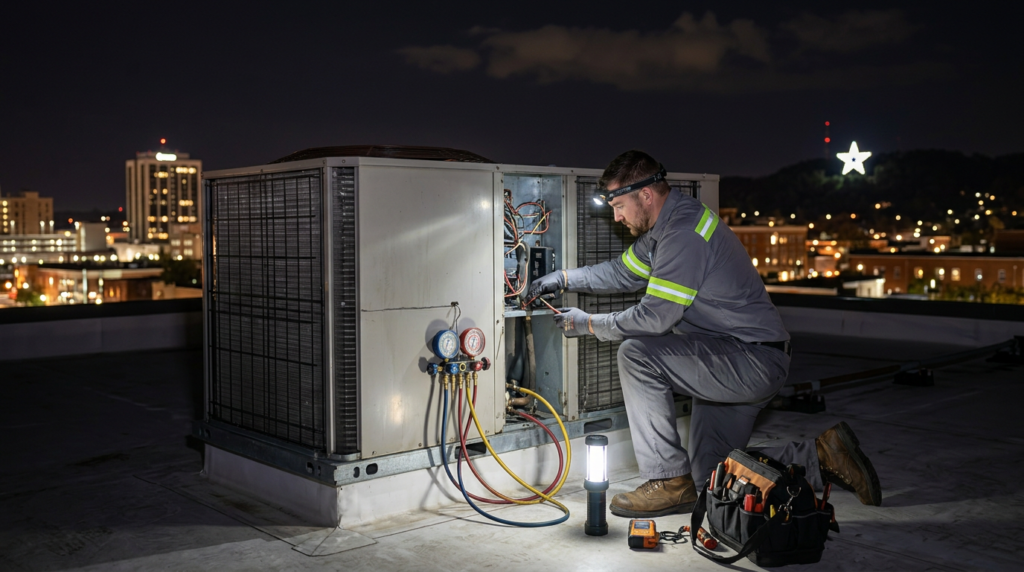
Quick answer: Call 24/7 emergency commercial HVAC service when a failure is actively threatening inventory, safety, or operations—think no cooling in a restaurant, a walk-in warmer rising fast, a burning smell, repeated breaker trips, or water pouring from equipment. If customers or staff can’t safely occupy the space, or you risk burst pipes or spoiled product overnight, it’s an emergency call.
Signs It’s an Emergency (Not a “Tomorrow” Repair)
If your system is down during business hours, the quickest way to decide is to ask: “Will waiting cause damage, spoilage, or a safety issue?” If the answer is yes, treat it as an emergency. A restaurant losing cooling, a medical office with temperature-sensitive supplies, or an office with a server room overheating can go from inconvenient to costly fast.
Decision checklist—call now if you notice: burning smell/smoke or visible sparking; repeated breaker trips or buzzing at electrical components; water actively leaking near electrical panels/controls; a walk-in or reach-in trending above a typical safe range (often around 40°F for refrigerated product) and still rising; a server/IT room climbing above a typical comfort range (many aim to keep it roughly in the 68–75°F range) with alarms or equipment warnings. These are general targets, not absolutes—your product specs and IT requirements control.
Clear red flags include a burning or electrical smell, smoke, sparking, loud metallic grinding, or a unit that keeps tripping the breaker. Refrigeration alarms, rapidly rising walk-in temps, and ice building up where it shouldn’t (like a frozen evaporator coil paired with warm product) also justify a call. If you’re in that situation, contacting Roanoke 24/7 emergency commercial HVAC service can connect you with help; an emergency technician may be able to stabilize conditions (e.g., stop leaks, restore partial cooling) depending on the fault and parts availability.
Water on the floor from an air handler, condensate line, or rooftop unit can be urgent too—especially near electrical panels, ceiling tiles, or finished spaces. Even if the cooling still “sort of works,” active leaks can create slip hazards and cause hidden building damage overnight.
What to Do While You Wait for the Tech
First, protect people. If you smell gas, see smoke, or suspect an electrical issue, shut the system off at the thermostat and, if safe, at the disconnect. Only qualified personnel should open electrical panels or operate disconnects, and if you smell gas, leave the area and call 911 and/or the gas utility before doing anything else. Evacuate if conditions feel unsafe and follow your building’s emergency procedures. For refrigeration, keep doors closed and limit product handling; every door opening dumps cold air and speeds temperature rise.
Second, gather useful details so the service call goes faster: the equipment type (rooftop unit, split system, walk-in, make-up air), any error codes, what changed right before the failure (power flicker, filter change, cleaning), and whether the problem is constant or intermittent. If you have multiple zones, note which areas are affected. A quick phone video of the thermostat screen, control board LEDs, or the leak location can also help.
Third, prevent additional damage. If a condensate pan is overflowing, shut the unit down and place containment (bucket, towels) to keep water away from electrical components. If a coil is iced up, turning the system off can reduce further icing; don’t chip ice with tools, which can puncture coils and turn a repair into a replacement.
Questions to Ask During the Emergency Call
A good emergency call is about speed and clarity. Ask for an estimated arrival window and whether the technician is equipped for your equipment type (especially for refrigeration controls, economizers, or variable-speed drives). If you have roof access requirements, security gates, or after-hours entry rules, share them immediately so nobody loses time on site.
Ask what “stabilization” might look like if a full repair can’t happen right away. Sometimes the immediate goal is to stop water damage, restore partial cooling, or keep a walk-in within a safer range until a part arrives. Also ask what information you should have ready: model/serial numbers, recent maintenance history, and any building automation system details.
If you’re authorizing work after hours, confirm who can approve repairs and what the tech should do if they find a major safety issue. Clear decision-making avoids delays when minutes matter.
When you call Nextech, you can say: “I’m at [site address]. We have [number] units—[types, e.g., 2 rooftop units and 1 walk-in]. The symptoms are [no cooling/strange noise/burning smell/leak], started at [time], and we’ve noticed [error code/temps]. Access is [roof hatch/ladder location/gate code], and the on-site contact is [name, phone] who can meet the technician.”